Techsstack

Tag: artificial-intelligence

  • Machine Learning Development Services

    Machine learning is no longer a futuristic concept—it’s a cornerstone of modern digital transformation. From personalized recommendations to predictive maintenance, machine learning development services are redefining how businesses make decisions, engage customers, and manage operations at scale.

    What Machine Learning Brings to Modern Businesses

    Machine learning (ML) helps businesses harness large datasets to extract insights, automate complex workflows, and deliver data-driven results in real time. Organizations across healthcare, finance, retail, logistics, and education are increasingly deploying ML models to drive strategic growth.

    Core benefits include:

    • Predictive Analytics: Forecast market trends and customer behavior with high accuracy.
    • Operational Automation: Replace repetitive tasks with intelligent systems.
    • Enhanced User Experience: Personalize content and services dynamically.
    • Real-time Decision-Making: Process large-scale data streams for faster insights.

    These capabilities are made possible through the evolution of both supervised and unsupervised learning algorithms, deep learning architectures, and real-time model training pipelines.

    Key Use Cases of Machine Learning

    The scope of machine learning has expanded dramatically in recent years. Below are several industries where its applications are already delivering measurable impact:

    1. Healthcare and Diagnostics

    ML models are transforming diagnostics by improving image recognition, predicting patient outcomes, and optimizing resource allocation in hospitals.

    • AI-assisted diagnostics reduce error rates by over 30% in radiology.
    • Predictive analytics in hospital systems help forecast patient admissions and manage ICU loads more efficiently.

    2. Finance and Fraud Detection

    The finance sector relies on ML to detect anomalies, predict credit risks, and automate trading strategies. It helps institutions prevent fraud in real time and ensure regulatory compliance.

    • Real-time transaction analysis prevents billions in fraud each year.
    • ML also powers robo-advisors that dynamically manage client portfolios.

    3. Retail and Customer Personalization

    Retailers leverage ML for dynamic pricing, inventory management, and personalized product recommendations. This enhances user engagement while boosting conversion rates.

    • Amazon attributes a significant portion of its sales to its recommendation engine.
    • ML also supports chatbots and virtual assistants for 24/7 customer support.

    4. Manufacturing and Predictive Maintenance

    ML algorithms in industrial IoT systems monitor equipment health, detect early signs of wear, and schedule maintenance without human intervention.

    • Predictive maintenance reduces equipment downtime by up to 40%, according to McKinsey.
    • Quality control processes also benefit from ML-driven anomaly detection.

    5. Logistics and Supply Chain Optimization

    From route optimization to demand forecasting, ML helps logistics companies reduce operational costs and improve delivery efficiency.

    • Real-time tracking combined with ML-based forecasting allows companies to anticipate delays and reroute shipments proactively.

    Building Scalable ML Solutions

    Developing reliable and scalable machine learning systems requires deep domain knowledge and technical expertise. Businesses often collaborate with a machine learning development company that can help them transition from data collection to full-scale deployment.

    Key considerations in ML project delivery include:

    1. Data Preparation: Clean, labeled datasets that align with business goals.
    2. Model Selection: Choosing the right algorithms for the task (e.g., regression, classification, clustering).
    3. Training and Validation: Iterative model tuning using training/test datasets.
    4. Deployment: Integration with existing applications or APIs.
    5. Monitoring and Retraining: Ensuring performance through continuous updates.

    For enterprises dealing with fragmented or siloed data systems, leveraging AI and ML in data integration becomes crucial. It enables unified, clean datasets that power smarter and more accurate models.

    Applications in Mobile and Web

    The demand for intelligent applications has grown, pushing businesses to collaborate with a machine learning app development company to bring ML-powered features to user-facing products.

    Whether it’s an app that recommends the next best action or one that uses computer vision for real-time object recognition, the integration of ML elevates the standard app experience.

    Typical features of machine learning app development services include:

    • Image and speech recognition
    • Predictive text input
    • Smart notifications
    • Behavioral analytics
    • Sentiment analysis for customer feedback

    These advancements are making ML an essential component of next-gen digital products, particularly when delivered by a capable ml development company with cross-platform deployment capabilities.

    Trends Shaping the Future of ML Development

    The ML landscape is constantly evolving, shaped by innovations in model architecture, computing power, and regulations. Some ongoing trends include:

    • TinyML: Machine learning on edge devices with minimal compute.
    • Federated Learning: Training models across decentralized devices without sharing raw data.
    • Explainable AI (XAI): Making models more transparent and interpretable.
    • AutoML: Automating the model development lifecycle to reduce human intervention.

    For companies looking to stay competitive, working with an AI integration services partner ensures their solutions evolve with the technology itself.

    Final Thoughts

    Machine learning has matured into a critical business enabler. Organizations adopting these technologies with support from a trusted ai ml development company are already seeing gains in efficiency, personalization, and scalability. By partnering with an experienced provider of machine learning development services, businesses can not only stay ahead but redefine what’s possible in their industry.
  • Building the Future with a Generative AI Development Company: 2025 Insights

    Generative AI is rapidly transforming industries, not just through automation, but by enabling machines to create—text, images, code, music, and even strategy. From revolutionizing content creation and product design to accelerating drug discovery and financial modeling, this new wave of AI is reshaping what businesses can imagine and execute.

    But the leap from idea to implementation requires more than off-the-shelf tools. It demands domain expertise, robust AI infrastructure, and a vision for scalability. That’s where partnering with a top-tier generative AI development company becomes critical.


    Understanding Generative AI: Beyond Buzzwords

    Generative AI refers to algorithms—often built on transformer models like GPT, BERT, or diffusion systems—that can generate content indistinguishable from human-created outputs. Unlike traditional AI, which classifies or predicts, generative systems create. This leap in capability is due to advances in:

    • Natural Language Processing (NLP)
    • Computer Vision and GANs (Generative Adversarial Networks)
    • Multimodal AI (text-to-image, text-to-video)
    • Large Language Models (LLMs)

    These models are trained on massive datasets and fine-tuned for specific industries, use cases, or business needs. With proper alignment, generative AI can become the foundation of intelligent digital ecosystems.


    Top Business Use Cases for Generative AI Development

    Today’s organizations—whether startups or Fortune 500s—are investing heavily in generative AI for tangible ROI. Let’s explore the most promising and adopted use cases across industries:

    1. Content Generation & Automation

    Businesses are using generative AI to:

    • Write SEO-optimized blogs, ad copy, social content
    • Automate email personalization at scale
    • Generate documentation and summaries

    In marketing and media, it reduces production time while enhancing creativity and campaign variety.

    2. Code & Software Development

    Tools like GitHub Copilot have already shown how GenAI can write, debug, and refactor code. Now, enterprise-grade solutions are helping companies:

    • Accelerate software delivery pipelines
    • Auto-generate documentation
    • Create low-code/no-code solutions with natural language

    3. Product Design & Prototyping

    Using text prompts or sketches, AI can generate prototypes of products, UX/UI designs, and 3D assets. This reduces iteration time and bridges the gap between idea and design.

    4. Finance & Risk Modeling

    Generative AI helps banks and financial institutions by:

    • Simulating market scenarios
    • Personalizing financial recommendations
    • Detecting fraud through synthetic data creation

    5. Healthcare & Life Sciences

    From molecule generation for drug discovery to automated clinical reports, the applications of GenAI in healthcare are game-changing. AI-generated synthetic data also aids in training without compromising patient privacy.


    What Makes a Strong Generative AI Development Firm?

    Selecting the right generative AI development firm is more than a checklist—it’s about alignment with your business goals. The ideal partner should offer:

    • Expertise in LLMs & AI architecture: Proven experience working with foundational models and adapting them to business needs.
    • Custom model development: Not just integrations with existing APIs, but building tailored models for enterprise use cases.
    • Compliance & governance: Building AI responsibly with explainability, fairness, and data security.
    • End-to-end service offerings: From consultation to deployment, model training to fine-tuning, support across the lifecycle.

    When evaluating generative AI development companies, prioritize those that combine innovation with ethical deployment practices, and have cross-domain knowledge in industries like finance, healthcare, logistics, and retail.


    Building a Scalable GenAI Strategy in 2025

    Implementing generative AI isn’t just a technical upgrade—it’s a strategic transformation. A leading generative AI development company can help you build scalable systems that:

    • Automate repetitive processes
    • Enhance customer experience with natural interactions
    • Increase agility in product design and R&D
    • Unlock new revenue models through AI-driven services

    As businesses mature in their AI adoption journey, the focus is shifting from experimentation to enterprise-grade deployment. The demand for Generative AI Development Services is surging globally, with North America leading adoption in 2025.


    Key Considerations Before Starting a GenAI Project

    Before you engage with a Gen AI development company, consider the following:

    ConsiderationWhy It Matters
    Data ReadinessClean, structured, and domain-relevant data is key
    Regulatory ComplianceVaries by region and sector (e.g., HIPAA, GDPR)
    Model ExplainabilityEspecially in sensitive areas like healthcare or law
    Infrastructure NeedsGPUs, model hosting, APIs, and DevOps readiness

    Aligning these elements ensures your generative AI efforts are not only effective but also secure and sustainable.


    Global Landscape: Generative AI Development Company in USA

    The United States is home to some of the most innovative AI startups and mature enterprises. Demand for Generative AI Development Company in USA is growing across sectors like fintech, ecommerce, gaming, and digital media. Organizations here prioritize innovation at scale, responsible AI use, and ROI-focused delivery.

    If your target market includes North America or Europe, working with a team experienced in those regulatory environments gives a crucial edge in speed, quality, and trust.


    Final Thoughts

    2025 marks a clear shift: generative AI is no longer a novelty; it’s a core driver of digital competitiveness. Partnering with the right generative ai services provider can determine whether you merely adopt AI—or lead with it.

    For businesses looking to innovate, scale, and stand out, choosing the right generative AI development company is one of the most important decisions of the decade.

    To explore what tailored GenAI development could look like for your business, visit:

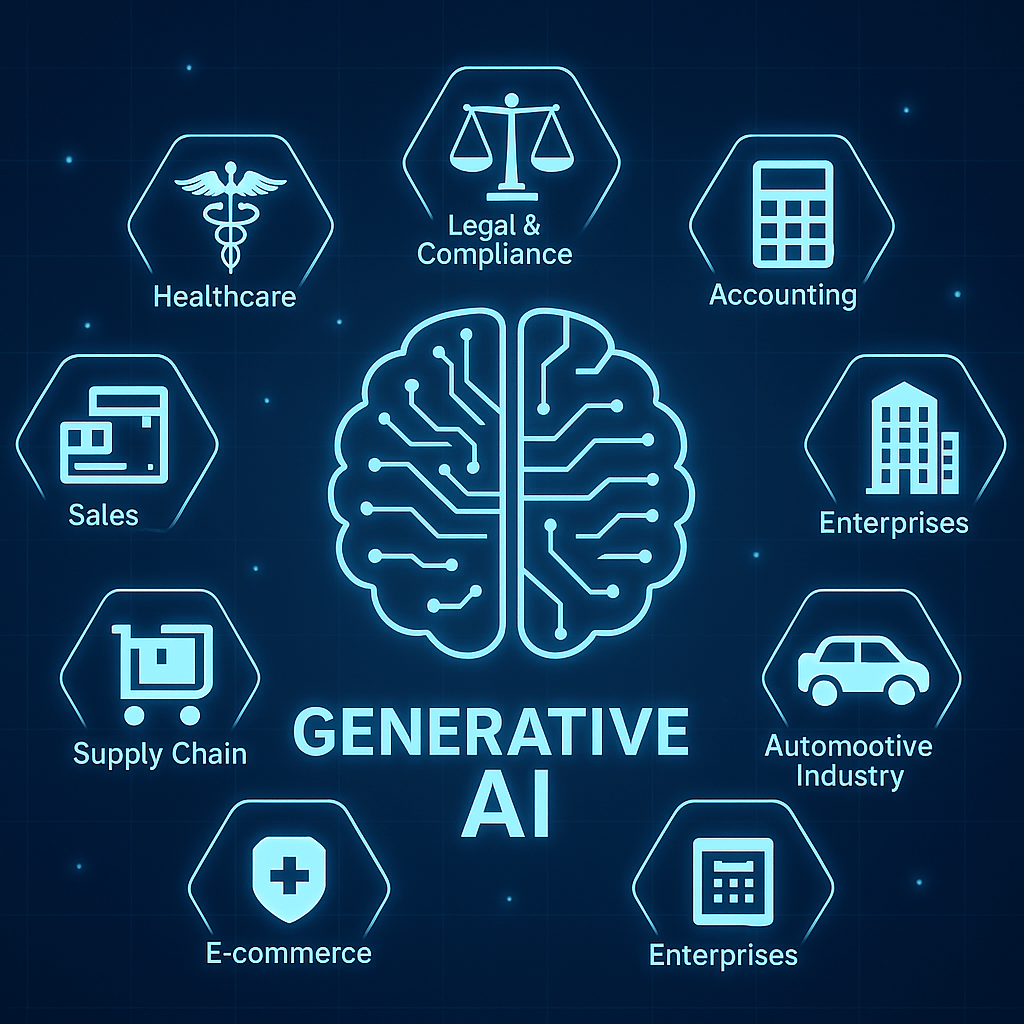
  • How Generative AI is Revolutionizing Industries: Real-World Applications and Opportunities

    Generative AI is Revolutionizing Industries:

    Generative AI has moved beyond theoretical use cases to become a transformative force across industries. From healthcare to automotive, enterprises are leveraging generative AI consulting services to boost efficiency, enhance decision-making, and unlock new business models. In this article, we explore the diverse applications of Generative AI across sectors, showcasing its evolving role as a critical enabler of innovation.


    Generative AI for Healthcare

    The healthcare industry is embracing generative AI to drive patient-centered innovation. Technologies like personalized treatment modeling, drug discovery acceleration, and automated diagnostics are reshaping how care is delivered.

    Key applications include:

    • Drug Discovery: Generative models predict molecule structures, significantly reducing R&D timelines.
    • Personalized Treatment Plans: AI analyzes patient data to recommend therapies tailored to genetic profiles.
    • Medical Imaging: AI enhances CT, MRI, and X-ray image quality, helping radiologists detect anomalies faster.

    Explore more about Generative AI in Healthcare

    Generative AI for Legal and Compliance

    In the legal sector, generative AI improves accuracy, saves time, and ensures regulatory compliance. Law firms and compliance departments now rely on AI for document analysis, contract generation, and risk assessment.

    Impact areas:

    • Contract Automation: Drafting legal documents faster with fewer human errors.
    • Compliance Monitoring: Tracking policy changes and ensuring company processes stay aligned.
    • Legal Research: Summarizing complex legal texts, saving hours of manual effort.

    Discover the full potential of Generative AI for Legal and Compliance.

    Generative AI in Accounting

    Accounting firms are experiencing a paradigm shift with the adoption of generative AI. Traditional manual bookkeeping tasks are evolving into intelligent, automated workflows.

    Applications include:

    • Automated Financial Reporting: AI generates real-time financial summaries.
    • Error Detection: Advanced models identify anomalies in large datasets.
    • Predictive Analysis: Offering CFOs future projections with higher accuracy.

    Learn more about Generative AI in Accounting.

    Generative AI in Sales

    Sales teams are leveraging AI to hyper-personalize outreach, forecast revenue, and improve lead conversions. Gen AI consulting services are now central to creating intelligent sales ecosystems.

    Strategic use cases:

    • Content Personalization: Crafting custom emails, proposals, and marketing assets.
    • Sales Forecasting: Predicting pipeline health with better precision.
    • Chatbots and Virtual Assistants: Automating initial customer interactions.

    Uncover how Generative AI is transforming Sales.

    Generative AI in Payments

    The financial payments industry faces constant pressure to innovate while maintaining security. Generative AI is fueling advancements in fraud detection, personalization, and transaction processing.

    Examples:

    • Fraud Detection: Real-time identification of suspicious transactions.
    • Personalized Recommendations: Tailored payment plans based on customer behavior.
    • Risk Management: Predicting and mitigating payment processing risks.

    Get deeper insights into Generative AI in Payments.

    Generative AI for Enterprises

    Across industries, enterprises are adopting AI not just for operational efficiency but also to fuel strategic decision-making and customer-centric innovation.

    Enterprise-wide applications:

    • AI-Driven Knowledge Management: Centralizing and contextualizing organizational knowledge.
    • Workforce Automation: Enhancing employee productivity through AI assistants.
    • Strategic Planning: Simulating scenarios and business models before market execution.

    Find out how Generative AI empowers Enterprises.

    Generative AI in Automotive Industry

    Automotive companies are integrating AI into their R&D, manufacturing, and customer experience strategies. Generative AI consultants help accelerate innovation cycles in this highly competitive market.

    Industry-specific applications:

    • Autonomous Vehicle Design: Creating safer vehicle navigation systems.
    • Predictive Maintenance: Anticipating component failures before they occur.
    • Customer Personalization: Designing custom vehicle features based on user preferences.

    Discover more about Generative AI in the Automotive Industry.

    Generative AI in Supply Chain

    Supply chains are increasingly complex, and AI offers solutions to predict, manage, and optimize logistics.

    Key transformations:

    • Demand Forecasting: Improving inventory management accuracy.
    • Logistics Optimization: Streamlining routes and warehouse operations.
    • Risk Mitigation: Identifying vulnerabilities and suggesting contingency plans.

    Explore the full story on Generative AI in Supply Chain Management.

    Generative AI in E-commerce

    E-commerce platforms are turning to generative AI to offer personalized shopping experiences, better customer support, and smarter inventory management.

    Highlights include:

    • Personalized Product Recommendations: AI tailors suggestions in real-time.
    • Content Generation: Automating product descriptions and marketing copy.
    • Chatbots: Offering instant and consistent customer support.

    Learn how Generative AI is reshaping E-commerce.

    Generative AI for Insurance

    Insurance companies are using generative AI to underwrite policies more accurately, improve claims processing, and create hyper-personalized policies.

    Applications:

    • Claims Processing: AI verifies and expedites claims faster than traditional methods.
    • Risk Assessment: Predictive modeling identifies high-risk customers.
    • Custom Policy Creation: Tailoring insurance products to niche market needs.

    Discover more on Generative AI in Insurance.


    Why Enterprises are Seeking Expert Generative AI Consulting

    Businesses across verticals are increasingly partnering with a trusted generative AI consulting company to customize their AI strategies. Tailored custom generative AI services ensure a faster go-to-market and competitive edge. Companies offering gen AI consulting services empower enterprises to bridge the gap between traditional business models and next-generation AI-driven approaches.

    For expert support and solutions, SoluLab stands out among top generative ai consulting companies, delivering business-specific innovation with measurable ROI.

    Explore our Generative AI Consulting Company services.


    Conclusion: Shaping the Future with Generative AI

    Generative AI is not just about automation; it’s about augmenting human capabilities, creating value, and reimagining business possibilities. From healthcare diagnostics to dynamic supply chains, from personalized shopping experiences to predictive legal compliance, industries are undergoing a profound transformation.

    To fully leverage these opportunities, partnering with experienced generative ai consultants who understand industry-specific challenges is crucial. SoluLab’s expertise in providing bespoke solutions ensures that businesses are not only ready for today but are prepared to lead tomorrow.

    Ready to drive transformation with Generative AI? Connect with SoluLab today.

  • The Expanding Role of AI Across Industries: A 2025 Perspective

    Artificial Intelligence (AI) is no longer a futuristic concept—it’s a foundational driver of innovation across sectors. From reshaping financial modeling in banks to enhancing patient diagnostics in healthcare, AI is enabling organizations to unlock unprecedented value, agility, and intelligence. The transformative impact of AI is evident in how businesses streamline processes, improve personalization, and make data-driven decisions faster than ever.

    This article explores how AI is being applied across different industries, based on recent real-world trends and practical implementations.

    AI in Finance

    AI has become the backbone of modern finance, helping firms manage risk, predict trends, and provide better client experiences. Intelligent systems are now used for fraud detection, algorithmic trading, credit risk scoring, and regulatory compliance.

    Predictive analytics and real-time data processing enable financial institutions to:

    • Detect anomalies across millions of transactions instantly
    • Automate portfolio management based on market sentiment
    • Perform dynamic credit assessments

    These capabilities have redefined how financial firms operate, making operations more secure and efficient. According to SoluLab’s insights on AI in Finance, leading institutions are increasingly investing in customized AI models tailored to their asset classes and trading algorithms.

    AI in Banking

    In the banking industry, AI enhances customer experience through personalized banking, chatbots, voice assistants, and AI-powered loan assessments. It also plays a pivotal role in anti-money laundering (AML) systems, where AI scans large datasets to flag suspicious activity.

    AI applications include:

    • Virtual banking assistants improving service response time
    • NLP-based chatbots resolving 80% of queries without human input
    • Document recognition software streamlining KYC and onboarding

    As highlighted in SoluLab’s coverage on AI in Banking, banks leveraging AI report reduced operational costs and enhanced customer retention through personalization.

    AI in Education

    AI is fundamentally reshaping how students learn and educators teach. Adaptive learning platforms, automated grading, and AI tutors help personalize the educational journey for every student.

    Key advancements in AI education tools include:

    • AI tutors providing real-time feedback to learners
    • Personalized content delivery based on individual performance
    • Predictive systems to identify at-risk students

    SoluLab’s take on AI in Education emphasizes how educational institutions are adopting AI to enhance learning outcomes while reducing administrative burden.

    AI in Healthcare

    AI’s impact on healthcare is profound—ranging from diagnostic imaging to precision medicine. Machine learning algorithms help physicians detect anomalies in radiology scans, while AI-driven platforms analyze genetic data to suggest personalized treatments.

    Real-world applications include:

    • AI-assisted surgeries with real-time visualization
    • Virtual health assistants handling patient triage
    • Predictive models anticipating chronic disease outbreaks

    In SoluLab’s AI in Healthcare article, it’s clear that AI is pivotal in enhancing accuracy, speed, and scalability in patient care delivery.

    AI in Travel and Tourism

    AI in travel focuses on personalized experiences, predictive pricing, and efficient operations. From booking to post-trip follow-up, AI ensures customer journeys are smooth and customized.

    Examples of AI in travel:

    • Intelligent recommendation engines based on past preferences
    • Real-time language translation and chatbot support
    • AI-driven route optimization for logistics

    As described by SoluLab, travel companies using AI report higher booking conversions and improved loyalty.

    AI in Manufacturing

    AI is ushering in the era of Industry 4.0. Manufacturers are deploying smart systems to monitor supply chains, forecast machine failure, and optimize production schedules.

    Impactful AI use cases include:

    • Predictive maintenance to reduce unplanned downtimes
    • Visual inspection systems for quality assurance
    • AI-enabled robotics on the factory floor

    According to SoluLab’s analysis on AI in Manufacturing, AI accelerates agility and productivity, which is vital in global manufacturing competitiveness.

    AI in BFSI (Banking, Financial Services & Insurance)

    AI is deeply embedded in BFSI operations, transforming customer onboarding, claims management, and financial advising. Intelligent agents can analyze behavioral data to predict product needs or spot fraud in real time.

    Popular applications include:

    • Robo-advisors offering personalized investment strategies
    • Insurance claim automation using AI document parsing
    • Regulatory compliance systems using NLP and machine learning

    Explore the full scope of AI’s financial reach in SoluLab’s AI in BFSI guide.

    AI in Media and Entertainment

    AI is powering creativity, automation, and audience engagement in the media landscape. From content recommendation to real-time CGI generation, AI tools enable both scale and precision.

    Transformative capabilities include:

    • Personalized content curation on OTT platforms
    • AI-generated music and video editing
    • Sentiment analysis for audience feedback

    As mentioned in SoluLab’s article on AI in Entertainment, these tools reduce production time and boost viewer retention.

    AI in Sports

    AI applications in sports analytics have revolutionized performance tracking, injury prevention, and fan engagement. Teams are using AI to gain competitive advantages through data.

    Key areas include:

    • AI cameras for player movement analysis
    • Real-time game strategy adjustment algorithms
    • Chatbots and AI content for enhanced fan interaction

    SoluLab’s AI in Sports overview demonstrates how AI is transforming both gameplay and sports business models.

    Choosing the Right AI Partner

    With such widespread use cases, businesses must choose a reliable AI development company that understands domain-specific challenges. A custom AI development company can design solutions aligned with unique business goals—whether you’re in fintech, edtech, or healthcare.

    When looking for AI development services in USA, it’s essential to prioritize partners that ensure data security, model accuracy, and scalability. SoluLab, a reputed Artificial intelligence development company, offers end-to-end AI development solutions for organizations aiming to stay ahead.

    Whether you’re seeking model customization, NLP integration, or full-stack deployment, partnering with a top-tier AI development agency can help realize your AI vision with precision.

    Conclusion

    AI is now a mission-critical capability, not just an innovation trend. It touches nearly every sector and function—from real-time fraud prevention to personalized learning and automated storytelling. By aligning your AI strategy with domain expertise and executional excellence, your business can leap ahead in both efficiency and customer value.

    SoluLab, among the top AI development companies, stands out with deep technical expertise and industry-specific AI implementations. If you’re exploring AI transformation, SoluLab offers customized solutions to help you lead the change.

  • AI Agents for Recruiting: A Guide for Hiring Teams

    As talent acquisition becomes increasingly competitive, hiring teams are turning to AI agents to enhance the recruitment process. From streamlining candidate sourcing to improving interview coordination, AI agents are reshaping how companies attract and evaluate talent. This guide explores how AI agent development solutions can revolutionize recruitment workflows and why HR departments are partnering with AI agent development companies to gain a strategic edge.

    What Are AI Agents in Recruiting?

    AI agents are autonomous software systems designed to perform specific tasks using artificial intelligence. In the recruitment domain, AI agents can automate and optimize functions such as resume screening, candidate matching, interview scheduling, and even onboarding processes.

    Unlike traditional software, AI agents continuously learn from data inputs, improving their performance over time. They combine natural language processing (NLP), machine learning (ML), and predictive analytics to make data-driven decisions in real-time.

    Key Benefits of AI Agent Solutions in Recruitment

    1. Enhanced Efficiency:

    • AI agents process thousands of resumes in minutes, filtering out unqualified candidates and shortlisting top matches.
    • Automated scheduling tools reduce manual coordination, freeing up recruiters’ time for strategic tasks.

    2. Improved Candidate Experience:

    • Conversational AI agents interact with candidates in real time, answering FAQs, updating on application status, and gathering additional details.
    • Personalized engagement improves employer branding and boosts candidate satisfaction.

    3. Reduced Bias:

    • By relying on data-driven assessments, AI agents help reduce unconscious bias in screening and evaluation.

    4. Data-Driven Insights:

    • AI-powered analytics offer insights into recruitment KPIs, such as time-to-hire, sourcing channel efficiency, and candidate drop-off rates.

    Use Cases of AI Agents in Recruitment

    FunctionAI Agent Use Case
    Resume ScreeningNLP algorithms rank candidates based on skill match
    Interview SchedulingAI bots integrate with calendars to book slots automatically
    Candidate EngagementVirtual recruiters interact with applicants through chat or voice
    Onboarding SupportAI agents guide new hires through forms and compliance steps

    Why Choose a Top AI Agent Development Company?

    To fully leverage the potential of AI in recruitment, it is essential to collaborate with a top AI agent development company. These companies specialize in creating customized AI agent development services that align with your business goals, existing tech stack, and recruitment strategy.

    SoluLab is a trusted provider of AI agent development solutions, offering end-to-end services from consultation to deployment. As a leading AI agent development company, SoluLab helps businesses build intelligent recruiting systems that are secure, scalable, and efficient.

    AI Agent Development Services: What to Expect

    When you work with a professional firm offering AI agent development services, you can expect:

    • Customized Development: Solutions tailored to specific recruitment workflows
    • Integration Capability: Seamless integration with ATS, HRMS, and other recruitment tools
    • Security and Compliance: Adherence to GDPR, EEOC, and other regulatory standards
    • Post-Deployment Support: Continuous training, updates, and performance monitoring

    To learn more, explore SoluLab’s comprehensive AI Agent Development Solutions.

    Future of AI Agents in Talent Acquisition

    The future of recruitment lies in intelligent automation. As more businesses embrace digital transformation, AI agents will play a pivotal role in enhancing recruiter productivity, improving decision accuracy, and delivering personalized candidate experiences at scale.

    Adopting AI agents isn’t just a trend—it’s a strategic necessity for organizations looking to attract top talent efficiently. By partnering with a top AI agent development company, HR teams can stay ahead of the curve and redefine the way they hire.

    Conclusion

    AI agents are no longer futuristic tools; they are practical, results-driven solutions that transform recruitment. Whether you’re a startup scaling fast or an enterprise optimizing complex hiring workflows, AI agent development solutions can be a game changer.

    Explore how SoluLab can help you harness the power of AI in recruitment and build intelligent, human-centric hiring systems that deliver measurable results.

  • From Classrooms to Clinics: How AI is Quietly Reshaping Our Daily Lives

    Artificial Intelligence (AI), it’s becoming an integral part of our everyday experiences. From the way we manage our finances to how we learn, travel, and receive healthcare, AI is streamlining processes and enhancing personalization. At the forefront of this transformation is SoluLab, a trusted generative AI consulting company offering comprehensive AI development services.​

    Banking on Intelligence

    In the financial sector, AI is revolutionizing how banks interact with customers and manage operations. SoluLab’s implementation of generative AI in banking has led to the development of AI-driven chatbots and virtual assistants that provide 24/7 customer support, offering personalized financial advice and real-time responses to queries. This not only enhances customer satisfaction but also streamlines banking operations.

    Personalized Learning Experiences

    Education is becoming more tailored, thanks to AI. SoluLab’s AI solutions in education analyze individual learning styles and academic data to create personalized learning paths. This approach ensures that each student receives customized content, improving comprehension and retention. By adapting to each learner’s needs, AI is making education more effective and engaging.

    Healthcare

    In healthcare, AI is enhancing diagnostic accuracy and treatment planning. SoluLab utilizes advanced algorithms to analyze vast medical data, aiding in early disease detection and personalized treatment strategies. By processing complex datasets, AI supports healthcare professionals in making informed decisions, ultimately improving patient outcomes.

    Travel

    Travel planning is becoming more intuitive with AI. SoluLab’s AI applications in the travel industry offer personalized recommendations and efficient customer service through AI agents. By analyzing user preferences and behavior, AI provides tailored travel suggestions, enhancing the overall travel experience.

    Manufacturing

    Manufacturing processes are being optimized through AI. SoluLab’s AI solutions in manufacturing include predictive maintenance, quality control, and supply chain optimization. By analyzing data patterns, AI helps in reducing downtime, improving product quality, and forecasting demand, leading to more efficient manufacturing operations.

    Why SoluLab?

    As a leading AI development company, SoluLab offers comprehensive AI development solutions across various industries. Their expertise in generative AI consulting services ensures that businesses can leverage AI to enhance operations, personalize customer experiences, and make data-driven decisions.​

    Whether it’s transforming banking services, personalizing education, advancing healthcare, tailoring travel experiences, or optimizing manufacturing, SoluLab’s AI development services are at the core of these innovations.​

    Embracing AI is no longer optional—it’s essential for staying competitive in today’s fast-paced world. Partner with SoluLab to harness the power of AI and drive your business forward.

  • The Business Case for Generative AI: Build Smarter, Create Faster, Scale Bigger

    In a time when innovation is currency, Generative AI has emerged as a critical pillar for businesses looking to stay ahead. From ChatGPT to Stable Diffusion, these technologies are no longer just emerging trends they’re reshaping entire industries.

    According to recent projections, the generative AI market is expected to reach $442.07 billion by 2031, driven by rapid adoption across sectors. Major investments—like Microsoft’s $1 billion stake in OpenAI urther confirm the long-term potential of this field, even amidst broader tech market fluctuations.

    Why Generative AI is a Business Essential

    Adopting generative AI is no longer optional. Here’s why more businesses are building with GenAI:

    • Efficiency: Automate time-consuming processes and free up creative teams.
    • Creativity: Generate designs, scripts, content, and more—faster than ever.
    • Productivity: Deliver outputs in minutes instead of weeks.
    • Savings: Reduce operational costs with AI-powered automation.
    • Data Insights: Uncover hidden trends from massive datasets.
    • Personalization: Build real-time, tailored user experiences at scale.

    Common Applications Across Departments

    Whether you’re in design, marketing, development, or operations generative AI has something for you:

    • Graphics & Visual Art: Turn concepts into polished visuals.
    • Photography: Restore and enhance images with stunning detail.
    • Audio: Produce lifelike narration and original music compositions.
    • Video: Edit and stylize footage at frame-level precision.
    • Text: Generate everything from email copy to knowledge base articles.

    📘 Want to go deeper? How to Create Your Own Generative AI Solution

    Building Your Own GenAI Stack: A Roadmap

    Step 1: Data Preparation
    Quality data is the foundation. Curate, clean, and structure your datasets before training.

    Step 2: Choose Tools & Frameworks
    From Python and PyTorch to OpenCV and AWS, select tools that align with your needs and scale.

    Step 3: Model Development
    Choose from architectures like GANs, VAEs, and LSTMs to suit your application text, image, or audio generation.

    Step 4: Optimize & Tune
    Fine-tune hyperparameters, apply regularization, and use tools like MLflow to monitor experiments.

    Step 5: Evaluate Performance
    Run quality checks, gather feedback, and iterate. Key metrics: relevance, fluency, latency, and coherence.

    Step 6: Deploy & Monitor
    Whether on-premise or in the cloud, use APIs and CI/CD pipelines to ensure stability and scale.

    Industry Case Studies

    • Finance: Fraud detection and AI-driven trading insights.
    • Healthcare: AI-based diagnostics and treatment recommendations.
    • Manufacturing: Design automation and predictive maintenance.
    • Retail: Dynamic ads, personalized product feeds.
    • Entertainment: Scriptwriting and background scoring.
    • Education: Adaptive learning modules and smart assessments.

    Partner with Experts to Unlock GenAI Value

    At SoluLab, we don’t just build AI we build success stories. As a specialized generative ai consulting company, our team helps brands craft bespoke generative AI products aligned with market goals and user intent.

    Our recent partnership with AmanBank led to the development of a GenAI-powered mobile banking assistant, designed to offer real-time support and personalized financial insights to over 750,000 customers.

    From vision to deployment, our generative ai consulting services are designed to help you move faster and smarter.

    Learn more about our generative ai consulting company

    Final Thoughts

    The next wave of digital transformation will be powered by generative AI. The technology is ready. The use cases are proven. Now it’s your move.

    Whether you’re starting from scratch or looking to scale, SoluLab’s experienced generative ai consultants and gen ai consulting services are ready to support your journey.

    Start building what’s next.

  • Empowering Creativity with AI in Content Creation

    Struggling to meet the relentless content demands of today’s digital world? You’re not alone. From entrepreneurs and marketing teams to digital agencies, content creation often feels like an overwhelming marathon demanding constant ideation, production, and optimization.

    Yet here’s the good news: AI isn’t here to replace you it’s here to elevate your craft. Think of it as a creative partner that amplifies your productivity, boosts consistency, and takes the grunt work out of your workflow. Whether it’s drafting SEO blogs, scripting product videos, designing carousels, or optimizing your outreach strategy AI’s role is rapidly evolving from assistant to co-creator.

    In fact, the global AI-powered content creation market reached $2.9 billion in 2024 and is projected to grow to $3.53 billion in 2025 (CAGR of 21.9%). Statista provides deeper insights into this trend.

    Why AI for Content Creation Is a Smart Business Move

    AI for content creation refers to using artificial intelligence technologies to streamline content ideation, creation, editing, publishing, distribution, and performance analysis. The ultimate goal? To empower teams to create more impactful content, faster and smarter.

    1. Better ROI through Smarter Strategy
    AI’s predictive analytics help brands evaluate what content formats, tones, and channels work best improving budgeting, campaign planning, and performance tracking.

    2. Competitive Awareness
    With AI tools, you can stay ahead of industry trends and refine your content to outperform competitors in engagement, pricing strategies, and niche messaging.

    3. Constant Flow of Fresh Ideas
    AI-powered tools like HubSpot’s Idea Generator and AnswerThePublic tap into audience sentiment and real-time trends, making brainstorming quicker and more relevant.

    4. Time and Resource Efficiency
    Why spend hours on manual scheduling, formatting, or editing when AI tools like Buffer, Grammarly, or Jasper can automate and enhance these tasks?

    5. Human + Machine = Impactful Content
    AI handles repetition. You handle storytelling. This synergy creates content that resonates—emotionally and strategically.

    Real-World Use Cases of AI Content Creation

    1. Content Writing and Scheduling
    AI tools assist in generating blog outlines, captions, ad copy, and auto-scheduling posts across platforms. Tools like ChatGPT and Lately.ai analyze content performance and tailor future posts accordingly.

    2. Scriptwriting with Smarter Drafts
    AI can map out narrative arcs, suggest dialogue, and predict audience reaction, while humans polish the emotional tone and nuance.

    3. Multilingual Reach
    AI translators like DeepL ensure seamless localization, preserving meaning and tone to expand your global reach.

    4. Video & Audio Automation
    Apps like Descript, Lumen5, and Pictory convert articles to videos, generate AI-powered voiceovers, and even handle background scoring.

    5. Graphic Design Without the Learning Curve
    Not a designer? No problem. Adobe Firefly and Canva’s AI features let you craft visually stunning posts with minimal effort.

    6. Content Ideation and Research
    AI identifies gaps, suggests formats, and analyzes competitors—ensuring your strategy remains dynamic.

    Tangible Benefits of AI Content Creation

    • Time Efficiency: Speed up writing, editing, and designing processes
    • Scale with Less: Produce high-quality content without needing large teams
    • Cost-Saving: Reduce outsourcing or hiring overhead
    • Data-Driven Strategy: Adjust in real-time based on analytics
    • Future-Proofing: Stay agile in an evolving digital environment
    • Fuel for Creativity: Let AI handle the mundane while you focus on innovation

    Looking Ahead: The Human-AI Collaboration Era

    AI doesn’t just assist; it evolves alongside you. Modern AI learning models employ spaced repetition, Socratic questioning, and intent-based prompting, making them ideal for content knowledge management and strategic ideation. The synergy of AI and human creativity promises a future where content is not only scalable but also meaningful.

    Instead of competing with machines, today’s creators thrive by working with them.

    Tools You Should Know

    • ChatGPT: For drafting everything from email subject lines to entire campaigns
    • Claude: A powerful conversational AI for scripting, coding, and creative writing
    • Pictory: Turn blogs into engaging videos
    • Lumen5: Create video content with simple text inputs
    • Canva AI: Build brand assets effortlessly

    Case Study: SoluLab x AI-Build

    SoluLab, a trusted Artificial Intelligence development company, recently partnered with AI-Build, a rising star in construction tech. The challenge? Implement generative AI to optimize CAD-based workflows, improve scalability, and reduce manual interventions.

    With our AI development services, we integrated intelligent automation and custom AI Development solutions empowering AI-Build to boost performance and save costs.

    Ready to Embrace the Future of Content?

    AI is not a trend—it’s a transformation. Whether you’re a startup or a global brand, integrating AI into your content strategy will elevate your voice, accelerate your output, and maximize your impact.

    Need help tailoring AI to your brand’s content goals? Hire a generative AI developer or speak with our experts today to get started.

  • Top Generative AI Consulting Companies You Should Know in 2025

    The Rapid Rise of Generative AI

    The global AI market, was worth $136.55 billion in 2022, and it’s only accelerating. With an expected CAGR of 37.3% through 2030, AI could hit $1,811.8 billion by decade’s end. Among this growth wave, generative AI is making waves—helping companies automate content creation, personalize services, and develop innovative digital experiences. As adoption increases, so does the demand for generative AI consulting services that help companies apply the tech effectively.

    How We Identified the Top Generative AI Consulting Companies

    This list was crafted after evaluating a set of key criteria: hands-on experience, customer feedback, product quality, team scale, flexibility, and cross-industry capabilities. We focused on companies delivering true business impact, not just flashy demos.

    The Top Generative AI Consulting Companies in 2025

    From SoluLab’s implementation expertise to BCG’s strategic roadmap services, these consulting companies have been carefully vetted. SoluLab, a top-tier generative AI consulting company, is especially recognized for delivering machine learning and NLP-based solutions that elevate customer experiences and ROI. Their work across retail, fintech, and healthcare showcases why they’re an industry favorite.

    Why Choosing the Right AI Consulting Partner Matters

    When it comes to generative AI consulting companies, the right partner does more than code—they understand your vision. These firms deliver full-spectrum services: from ideation to deployment. Whether you’re building a chatbot, enhancing internal tools, or launching an AI-first product, their strategic and technical support keeps your business future-proof.

    Conclusion: Invest in the Future with the Right AI Partner

    AI is reshaping how we build and operate businesses. The top generative AI consulting companies featured here offer the tools, insight, and experience to bring your ideas to life. If you’re ready to begin, connect with SoluLab and explore how their customized solutions can fuel your next growth chapter.

  • Your Guide to AI Agent Development: Strategies, Frameworks, and Real-World Use Cases

    AI agents are no longer just a futuristic concept—they’re a present-day force reshaping the way businesses operate. As organizations aim to streamline processes, deliver smarter customer experiences, and scale decision-making, AI agent systems have taken center stage.

    With the global AI market set to hit nearly $2 trillion by 2030, understanding how to build and integrate AI agents can provide your business with a definitive competitive edge. This article will guide you through the essentials of AI agent development, including types, environments, tools, and how to get started with an experienced AI Agent development company.

    What Are AI Agents, and Why Do They Matter?

    AI agents are autonomous systems capable of perceiving their environment, analyzing data, making decisions, and taking action without constant human input. Unlike basic scripts, these agents learn, adapt, and respond in real time—making them valuable in every industry from logistics to legal, from eCommerce to energy.

    Rather than replacing jobs, AI agents are complementing human talent. Studies show that 62% of employee time is spent on repetitive tasks—tasks that AI agents can now handle.

    6 Types of AI Agents in Action

    1. Simple Reflex Agents

    • Function: Reacts to specific conditions with rule-based decisions.
    • Use Cases: Chatbots, alerts, basic automation scripts.

    2. Model-Based Agents

    • Function: Uses internal models of the world to make decisions.
    • Use Cases: Robotics, diagnostic systems, self-driving cars.

    3. Goal-Based Agents

    • Function: Targets specific objectives and makes choices accordingly.
    • Use Cases: Predictive analytics, automated design, and planning systems.

    4. Utility-Based Agents

    • Function: Makes the best possible decision by calculating utility value.
    • Use Cases: Portfolio optimization, recommendation systems.

    5. Learning Agents

    • Function: Continuously improves performance through feedback.
    • Use Cases: Streaming recommendations, AI tutors, adaptive eLearning.

    6. Hierarchical Agents

    • Function: A top-level agent coordinates multiple sub-agents for complex workflows.
    • Use Cases: Smart homes, search & rescue drones, industrial automation.

    For deeper technical insights, check out: How to Build an AI Agent System

    Where Can You Use AI Agents?

    AI agents can operate in a variety of environments:

    • Virtual Environments for training, simulation, or modeling
    • Physical Spaces like manufacturing floors or hospital wards
    • Digital Applications including travel booking apps, legal contract analysis, social media moderation
    • Financial Systems where they detect fraud or manage trading strategies

    Step-by-Step: How to Build Your AI Agent System

    1. Establish the Objective

    Ask: What problem will the AI agent solve? Define scope, data needs, and outcomes.

    2. Choose a Framework

    Use TensorFlow, PyTorch, or Keras depending on your application’s complexity.

    3. Pick the Programming Language

    Python is the go-to due to extensive support and pre-built libraries.

    4. Gather and Prepare Data

    Whether through APIs, databases, or crowd-sourcing—your model is only as good as your data.

    5. Design System Architecture

    Prioritize scalability, modularity, performance, and integration with existing tools.

    6. Model Training

    Use supervised and reinforcement learning techniques. Validate and fine-tune.

    7. Deploy Your Agent

    Containerize the system using Docker or deploy using serverless architecture for flexibility.

    8. Test for Performance

    Use unit testing, integration testing, and user acceptance tests to ensure the agent performs reliably.

    9. Monitor & Optimize

    Continually feed new data, retrain models, and adjust for evolving use cases.

    Use Case: InfuseNet AI Agents by SoluLab

    SoluLab, a top AI agent development company, recently developed a sophisticated AI agent system for InfuseNet—a platform designed for real-time data analysis and operational optimization. By integrating GPT-4 and FLAN models, SoluLab delivered agents capable of autonomous task execution and decision-making.

    These agents improved time-to-decision, eliminated manual processing bottlenecks, and ensured data compliance—all in real-time. The success of this project showcases what’s possible when domain expertise meets cutting-edge ai agent solutions.

    Why Choose SoluLab?

    At SoluLab, we help businesses build smart, secure, and scalable AI systems that drive efficiency and innovation. As a trusted name in AI Agent development services, we handle:

    • Custom agent design
    • Architecture development
    • GPT-based solution integration
    • Continuous support and optimization

    If you’re ready to explore intelligent automation, connect with our experts and begin your AI journey with confidence.

Design a site like this with WordPress.com
Get started